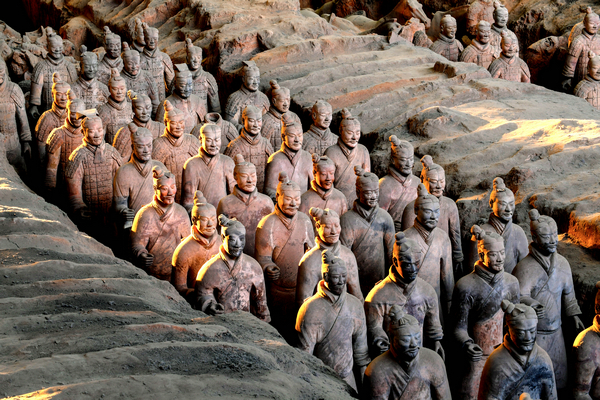
Emperor Qinshihuang's Mausoleum
Overview
Emperor Qinshihuang's Mausoleum, located at the foot of Lishan Mountain in Lintong district, Xi'an, Shaanxi province, is one of China's most significant historical and archaeological sites. It serves as the final resting place of Qin Shi Huang, the first Emperor of a unified China under the Qin Dynasty (221-206 BC). The site is famously guarded by the Terracotta Army, a collection of life-sized clay soldiers, chariots, and horses, which were constructed to accompany the emperor in the afterlife. Over the centuries, it has captivated historians, archaeologists, and tourists alike, earning its place as a UNESCO World Heritage Site and a National AAAAA tourist attraction in China. Covering an area of approximately 56.25 square kilometers, the mausoleum complex is noted for its grand scale and wealth of burial objects.
Historical Significance
The mausoleum of Qin Shi Huang holds immense historical significance as it marks the burial site of China's first emperor, who played a pivotal role in unifying the country. Qin Shi Huang's reign was marked by significant advancements, including the standardization of weights and measures, the establishment of a centralized bureaucracy, and the construction of a vast network of roads and the precursor to the Great Wall of China. The construction of his mausoleum, which took 37 years and approximately 720,000 laborers to complete, reflects the emperor's power and the architectural ingenuity of the time. The Terracotta Army, designed to protect the emperor in the afterlife, provides invaluable insights into the military organization, armament, and artistic expressions of the Qin era. Each warrior is uniquely crafted with distinct facial features, expressions, and armor, reflecting the diversity and individuality within the imperial army.
Layout and Structure
The mausoleum complex is divided into an inner and outer city, both rectangular in shape. The tomb itself is located in the southern part of the inner city. Originally standing at a height of 115 meters, the mausoleum has been reduced to around 70 meters due to weathering over the centuries. The site includes various structures such as the subterranean palace, city walls, gates, and numerous burial pits. Historical texts such as the "Records of the Grand Historian" by Sima Qian detail its elaborate construction, which included intricate traps to deter grave robbers and a model of the emperor's empire, complete with flowing rivers made of mercury. The Terracotta Army pits are situated approximately 1.5 kilometers east of the mausoleum. These pits house the famed Terracotta Warriors, chariots, and horses, meticulously crafted and arranged to represent a formidable military formation, reflective of the emperor's desire for protection in the afterlife.
Archaeological Discoveries
The discovery of the Terracotta Army was one of the most significant archaeological finds of the 20th century. It began in March 1974 when local farmers stumbled upon fragments while digging a well. Subsequent excavations unveiled three main pits, designated as Pit 1, Pit 2, and Pit 3, containing approximately 6,000 warriors and horses. These life-sized figures are unique, each with distinct facial features, clothing, and armaments, illustrating the high level of craftsmanship and artistry of the period. The warriors also bore real bronze weapons, and evidence of vibrant paint has been found on some figures. Further archaeological efforts, including a third excavation from 2009 to 2019, have unearthed additional warriors, weapons, and artifacts, enriching our understanding of Qin Dynasty military practices.
Museum and Exhibition
The Emperor Qinshihuang's Mausoleum Site Museum, commonly referred to as the Terracotta Warriors Museum, serves as a specialized institution dedicated to the display and preservation of these ancient relics. Opened to the public in 2010, the museum encompasses the main terracotta sites, including Pits 1, 2, and 3, as well as the Qin Shi Huang's Mausoleum Site Park (Lishan Garden). The museum offers visitors an opportunity to view over 7,000 pottery soldiers, horses, chariots, and an array of other archaeological wonders. Special exhibitions, such as those held in collaboration with the Shandong Museum, highlight the cultural diversity and historical significance of the Qin Dynasty, providing educational insights into ancient Chinese civilization.
Preservation and Restoration Efforts
Preservation and restoration of the Terracotta Army and related artifacts are critical, given their age and historical value. Teams of conservator-restorers, like those led by specialists such as Lan Desheng, work meticulously to piece together and restore these relics to their original state. The conservation process involves minimal intervention, focusing on maintaining the integrity of the relics while safeguarding elements such as the varnish and colorful painting. Techniques include stabilizing temperature and humidity to prevent damage and employing organic solvents to reinforce the figures. Continuous research and advancements in conservation technology aim to preserve these artifacts for future generations, ensuring they remain a testament to the ingenuity of ancient Chinese artisans.
Cultural and Educational Impact
Emperor Qinshihuang's Mausoleum has a profound cultural and educational impact, both nationally and globally. As a symbol of China's rich history and cultural heritage, the site attracts millions of visitors annually, fostering a deeper understanding and appreciation of ancient Chinese civilization. The Terracotta Army, often referred to as the "eighth wonder of the world", captivates audiences with its historical significance and artistic merit. Educational programs, exhibitions, and research initiatives associated with the mausoleum contribute to the study of archaeology, history, and conservation, inspiring scholars and enthusiasts alike. The site's inclusion in cultural narratives and academic curricula underscores its enduring legacy as a cornerstone of world heritage. Article reference1. Emperor Qinshihuang’s Mausoleum National Archaeological Site Park. chinaservicesinfo.com. 20212. Terracotta Warriors celebrate 50 years. chinaservicesinfo.com. 20243. Restorers piece together terracotta warriors. chinadaily.com.cn. 20204. A glimpse of the past: Int'l students tour Xi'an. chinadaily.com.cn. 2017Photo Gallery(36 pictures)CategoriesCultural HeritageTagWorld Heritage in ChinaTangible Cultural HeritageArchaeological DiscoveryCultural LandscapeRelatedYellow River CivilizationCatalogue1. Overview2. Historical Significance3. Layout and Structure4. Archaeological Discoveries5. Museum and Exhibition6. Preservation and Restoration Efforts7. Cultural and Educational Impact- - - []








